









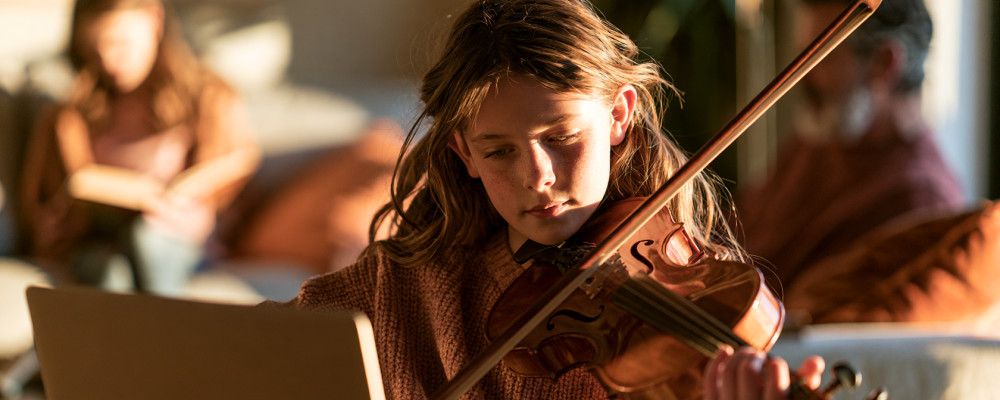
The three questions we hear most from parents are: "do online music lessons really work?", "will my child learn as well as in person?", "is my instrument suited to it?". The honest answer is neither a universal "yes" nor a "no": it depends above all on where the student is starting from. Someone who has never held an instrument needs something a screen cannot give. Someone who already has a sound basic technique, on the other hand, gets from online lessons exactly what makes the difference in the long run: continuity.
Why building basic technique calls for being there in person
Teaching a complete beginner through online lessons is not an approach we recommend. It is not a matter of bandwidth or video quality: it is the nature of what is being taught.
Basic technique is a bodily matter. It concerns the hand closing around the bow or arching over the keys, the lips finding the embouchure of a brass or woodwind instrument, the feet placed on the harp's pedals or holding a double bass player's balance, the back and shoulders of a pianist that must stay free while the arms work. These are fine balances, and students almost never notice when they get them wrong.
In person the teacher can point and, when needed, touch: move an elbow two centimetres, release a tense shoulder, rotate a wrist slightly, correct the way a thumb rests. It is an immediate gesture that at a distance turns into a long verbal explanation, with the student trying to translate it while watching themselves in a mirrored screen. The risk is not only slowness: it is that a wrong position becomes ingrained. And an ingrained wrong position takes months of work to undo — sometimes it leads to tension and minor injuries.
What online does better than anything else: consistency
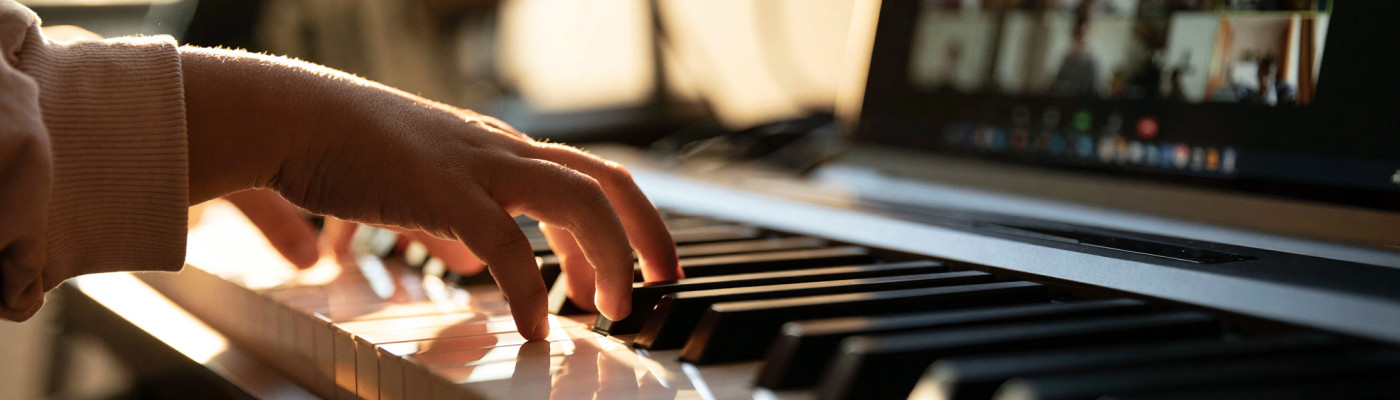
This is where the real value of distance teaching lies, and it is a considerable one. In learning an instrument, the factor that weighs most is not the single memorable lesson: it is continuity. One lesson a week, every week, for years.
And continuity is exactly what real life keeps calling into question. A week with the flu, a work trip for the parent who does the driving, a temporary move, snow, a transport strike, exam season at school, the teacher out of town for a concert. Every time, in a purely in-person path, the answer is the same: lesson cancelled. Two or three cancellations in a row and the student slips back, loses motivation, in some cases gives up.
Having the online option as well changes the answer to all of these: the lesson happens anyway. It is not a lesser fallback, it is what holds the path together at the moments when it would otherwise break. Many families and many teachers discover that the platform's greatest benefit is not replacing the studio, but never losing the thread.
Studying with a teacher who lives far away
There is a second advantage no studio can offer: working with teachers on the other side of the world, or who for a certain period are on tour, in an artistic residency, abroad for a festival.
For an intermediate or advanced student, being able to take a few lessons with a master they admire — and would otherwise never meet — is a genuine formative opportunity. It works the other way round too: a teacher who travels is no longer forced to suspend work with their students while away. On this ground online lessons are not a substitute for presence: they are something that simply did not exist before.
After the basics: what works well at a distance
Once the initial phase is over, with a student who has acquired the fundamentals of posture and approach to the instrument, distance work holds up very well — provided the platform's audio is up to the task.
Piano. The best suited instrument. The camera can frame from several angles (front, above the hands, from the side for posture) and with stereo audio the teacher hears real dynamics. Work on repertoire, phrasing, fingering, memory and section practice proceeds almost as it would in the studio.
Strings. Vibrato, bowing, the colour of the attack: it all comes through if the audio is not compressed. On a meeting platform vibrato flattens out and the teacher is effectively blind; with 48 kHz stereo the problem disappears. What remains harder is everything concerning the body: the shoulder rest setup, the height of the right elbow, the weight of the arm on the bow.
Winds. Work on articulation, breathing, intonation and repertoire works well. The embouchure, however, is territory for being there in person: it is the part of the body hardest to correct through a screen.
Singing. It works, provided you turn off the browser's DSP filters: noise cancellation destroys a singing voice. Work on repertoire, interpretation, diction and musicality comes across very well; support and breathing ask for more presence, at least at the start.
Guitar. Fine for everything that follows the setting of the right and left hand. The electric guitar is even more convenient at a distance, because the clean signal comes straight from the preamp.
Theory, harmony, ear training, score reading. Here online is better than in person: screen sharing lets you work on the same musical file together in real time, and every annotation stays with the student.
Where online stays difficult
Drums. The most demanding case, for acoustic before pedagogical reasons: the volume of an acoustic kit drives any USB microphone into clipping. You need an electronic kit, or two dedicated microphones and an audio interface.
Ensemble and chamber music. Internet latency, even just 50 milliseconds, makes playing together in real time impossible. Rehearsing together requires being in the same room. What does work very well at a distance is individual work on the parts, sight-reading, formal analysis and guided listening to recordings.
The student's age
It matters, but not in the way people imagine. For young children (5-7 years) presence is even more decisive: attention in front of a screen is short and the whole technical basis has yet to be built. From 8-9 years upwards, and always after the initial in-person phase, online holds up well if the lesson is structured in short segments with a change of activity every 10-15 minutes. For adults picking the instrument up again after years, a mixed path is often the only genuinely sustainable one.
The formula that works: hybrid
It is not a compromise: it is the answer. Basic technique and physical corrections in person, continuity guaranteed by online lessons. In practice this means an in-person path in the initial phase, then an alternation that takes real life into account: weeks in the studio, weeks at a distance when needed, never interrupting.
For instruments that are "difficult" at a distance (drums, ensemble playing) the in-person share stays higher. For theory and repertoire almost everything can be done online.
What parents should ask
Three questions, in this order. First: how is the initial phase organised? If the answer is "everything online from day one", it is worth digging deeper. Second: what is the platform's audio quality? A meeting platform compresses exactly what needs to be heard. Third: is there a lesson log to follow progress over time? On structuring the path you may also find our guide for teachers on how to structure an online lesson useful.
In short
You do not learn to play from scratch in front of a screen: the setting of hands, lips, feet and back is built in person, where the teacher can point and touch. But once the foundations are laid, online teaching becomes valuable for the reason that matters most in learning an instrument: it lets you never interrupt, whatever happens, and it opens the door to masters who live far away. Continuity and access: that is what online adds to a serious musical path.
Want to see how it works? Sign up for free on uwClassrooms and take a trial lesson with your teacher.